
Faster carbon emission cuts won’t be achieved solely through a shift to EVs. Streamlining the combustion vehicle parc could have an equally big impact as electrification gains traction
The automotive sector is accelerating toward a more sustainable approach, with electrification a key tool on the journey. Unfortunately the path to carbon‑neutral mobility remains a long-term target with hurdles left to overcome; the global fleet is vast, slow to renew, and structurally carbon‑intensive.
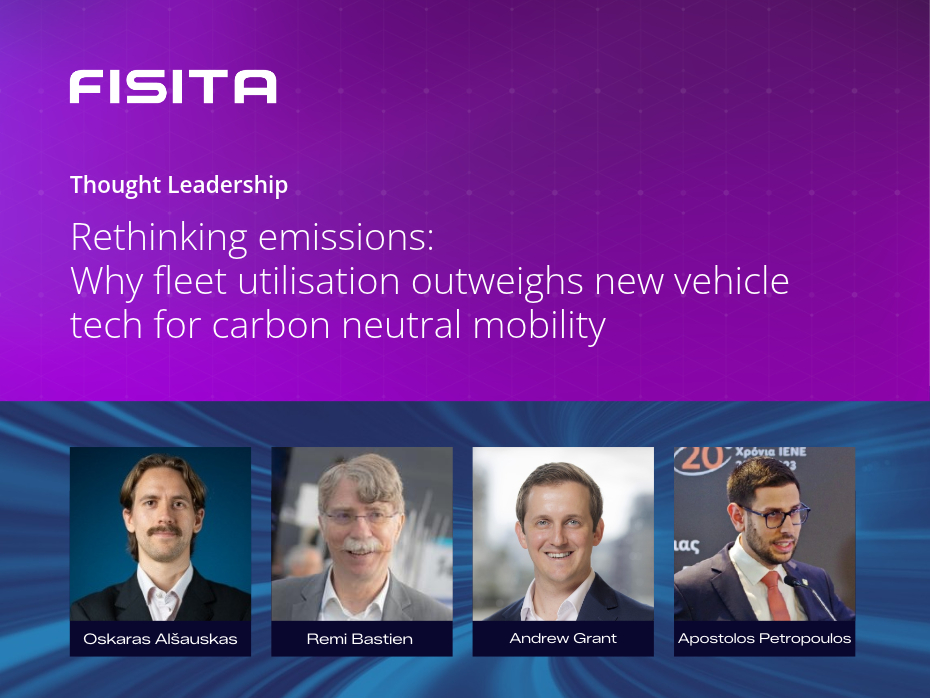
FISITA’s Rethinking emissions: Why fleet utilisation outweighs new vehicle tech for carbon neutral mobility webinar brought together FISITA’s Special Advisor to the CEO Rémi Bastien, Oskaras Alšauskas and Apostolos Petropoulos from the IEA and Andrew Grant from BloombergNEF. The panel examined why fleet utilisation – not just new vehicle technology – must become a strategic lever in long‑term decarbonisation.
Bastien set the tone early, emphasising that even aggressive electrification cannot erase the emissions locked into today’s vehicles. As he said, “100% BEV global sales from 2035 can’t achieve zero CO2 in 2050.” The global fleet is heading toward 1.8 billion vehicles, with an average lifespan of 17 years and a renewal cycle exceeding 20 years. This inertia slows the impact of new technologies, no matter how rapidly they scale, meaning the challenge shifts from simple product transition to system optimisation.
Defining the next 25 years
The IEA’s Oskaras Alšauskas reinforced this point with the organisation’s modelling: vehicles already on the road before 2024 will account for “about 25% to 50% of cumulative road‑sector emissions until 2050,” depending on the scenario. More critically, the next decade of sales will lock in another 50% of cumulative emissions. As Alšauskas said: “Acting early matters. It matters significantly.”
Electrification is accelerating, EV sales reached 20 million in 2025 and are forecast to hit 23 million in 2026, representing 28% of global sales, but the fleet turns over slowly. ICE vehicles sold today will still be emitting into the 2040s. This creates a structural emissions backlog that electrification alone cannot clear.
The IEA’s Petropoulos expanded the system‑level view, highlighting that transport is responsible for “around 50% of the drop” in CO2 required under stated‑policy scenarios. Yet even in net‑zero pathways, demand growth driven by population and economic expansion means the sector must rely heavily on efficiency and electrification. EVs consume “70 to 80% less energy compared to ICEs,” but efficiency improvements in conventional vehicles and operational behaviour remain essential.
Emissions persist
BloombergNEF’s Grant highlighted the divergence across global markets. While EV sales are still on track for a record year, “momentum is slowing a bit, particularly in some of the major markets,” and many regions will continue to see growth in ICE emissions well into the 2030s. Even in BloombergNEF’s bullish outlook, “you still end up with a big chunk of… internal combustion engine vehicles on the roads in 2050,” said Grant.
Grant also underscored the scale of future electricity demand. EV charging will rise from 367 TWh in 2025 to nearly 5,000 TWh by 2050 – while the global average is about 6% of total electricity demand from road transport, some markets will be closer to 20% of electricity demand by 2040 from EVs. And while grids are decarbonising, “very few markets go to zero” emissions intensity in BloombergNEF’s economic‑transition scenario, meaning EVs will not be fully zero‑emission at the point of use for decades.
The overlooked lever
Optimising the current vehicle fleet could play a huge role in decarbonising mobility as the industry electrifies. Bastien highlighted modelling that shows operational measures including carpooling, eco‑driving, low‑resistance tyres, low‑friction oils and higher biofuel blends, can collectively deliver a 35% CO2 reduction. In Europe, this is equivalent to replacing 110 million internal combustion vehicles with BEVs by 2030. As Bastien emphasised, “A better use of the existing fleet brings a similar effect as the shift to BEV until 2050.”
The conclusion across all the webinar’s speakers was clear: shifting technologies alone can’t deliver carbon neutrality as quickly as we want. Fleet utilisation must become a strategic priority, supported by policy, energy‑sector decarbonisation and coordinated industry action, if the industry is to accelerate its gains.
Carbon‑neutral mobility will not be achieved solely by building cleaner vehicles, but by using the vehicles we already have more intelligently; a shift from product thinking to system thinking that will define the next era of sustainable transport.
About the speakers
Rémi Bastien is the former Special Advisor to the FISITA CEO, Oskaras Alšauskas is Energy Modeller and Analyst at IEA, Apostolos D. Petropoulos is Energy Modeler at the IEA and Andrew Grant is Head of Intelligent Mobility at BloombergNEF
Watch the Rethinking emissions: Why fleet utilisation outweighs new vehicle tech for carbon neutral mobility webinar.
Download the FISITA Special Report that formed the basis for the webinar.
Find out more about the Carbon Neutral Mobility Expert Group, become a member, and help contribute to the advancement of the mobility and automotive sectors.