
The shift to software-defined vehicles is more than a technical upgrade, it’s a cultural revolution. Explore how legacy manufacturers need to evolve to stay relevant in a market driven by intelligence, integration, and speed.
– By Dr Partha Goswami
The automotive industry is facing the biggest transformation in its history. Legacy automakers are attempting to embrace a software-first model for developing cars, while at the same time competing with a new generation of automakers such as Tesla, Xiaomi, and Xpeng, who envision the automobile as a smart, intelligent device.
The transition, arguably, isn’t just about technological evolution, but organisational, cultural, and leadership transformation.
Software-first organisations
Deep organisational change is essential for legacy OEMs to transition to a software-defined vehicle (SDV) architecture and move beyond the traditional product development model. Historically, OEMs operated in siloed structures where the company is organised around vehicle sub-systems such as body, chassis, and interior. In turn, product development is focused primarily on integrating these sub-systems, the electronics hardware and controls usually come as a black box, and embedded software remains unchanged throughout product lifecycle. That’s changing, and companies need to adapt if they hope to remain competitive.
The new software-first design philosophy inherent in an SDV service-oriented architecture envisions every automotive function as an application orchestrated by a central or zonal computer, using data from multiple sensors and sub-systems. In principle, this involves defining system behaviour and abstractions in software, allowing underlying decoupled hardware implementations to follow these requirements.
Cross-functional interdependence
In contrast to the integration of stand-alone systems, a single function in the new architecture could depend on the state of multiple subsystems. An operation as simple as a turn signal, may influence or be influenced by real-time data from several operations, including automatic lane change, side blind zone alert, camera-based digital mirror operation, or adaptive matrix headlights.
This inter-dependency drives concurrent development and collaboration across multiple disciplines, getting rid of silos, and driving a complete overhaul, not just of design and integration, but also of the organisational structures behind them.
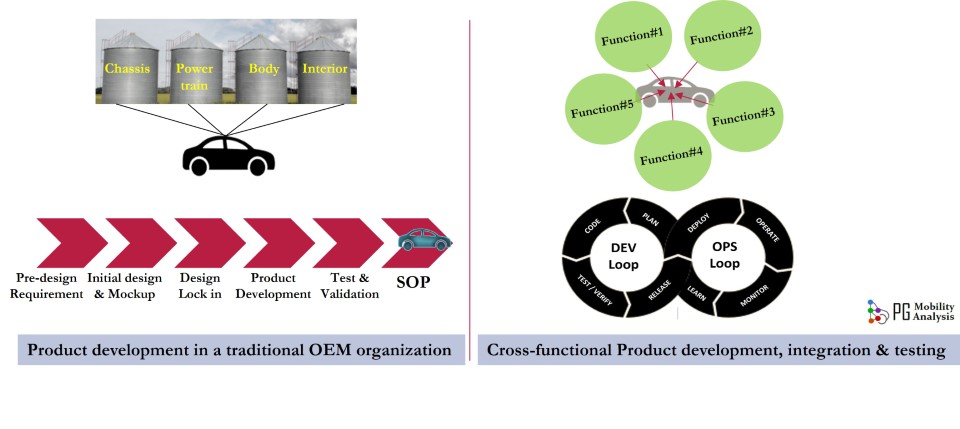
A shifting approach goes beyond purely the development programme for vehicles, but also what happens after they’ve launched into the market. The legacy approach in a traditional OEM is a linear process, with hard milestones, ultimately leading to vehicle launch, after which the OEM typically maintains very little relation with the product, except to support warranty commitments.
The shift to SDVs means that the OEM has the responsibility to maintain and update the software, refreshing or adding new features throughout the product lifecycle. Gone are the days when the product team is dismantled after start of production; instead, they must stay with the product in a continuous loop of updates and validation. It’s often referred to as Continuous Integration/Delivery/Deployment/Testing, or CI/CD/CT.
Cross-functional leadership
These new continuous and iterative development cycles are fundamentally different from the deeply ingrained processes that the automotive industry has refined over decades, and demand a new agility to support nimble and less hierarchical decision making. Anecdotal evidence suggests that software-centric EV brands such as Tesla, Rivian, NIO, and XPENG have quicker, leaner, and more cross-functional development teams that lead to faster decision making. It’s one reason they’ve been able to make such an impact on the market.
“The transition isn’t just about technological evolution, but organisational, cultural, and leadership transformation”
Shifting from a long-established organisational structure, based on silos, to a nimbler cross-functional framework is an incredibly disruptive endeavour. Combining the best of agile development with the rigorous safety and reliability of the automobile is a complex cultural change that cannot be achieved merely by adding a new SDV unit, or launching a separate subsidiary, or hiring new talent. The change is effective only when the entire organisation understands and embraces the new cross-functional philosophy of rapid development cycles, without compromising the time-tested focus on automotive safety.
The cultural change needs to permeate the whole organisation. This is particularly critical for large mainstream OEMs that are home to numerous brands and marques, including Stellantis, VW, GM, and Toyota.
Factory and business software models
A foundational requirement for transitioning to a software-defined future is the capability to develop and own your software. This year, one automaker and its software firm faced execution delays due, at least partially, to its attempt to set up its software factory. This needs an organisational structure promoting strong interaction between software architects and developers, robust software lifecycle management with internal traceability, and seamless integration with the internal and third-party ecosystem. Get it wrong and the impact can be considerable.
SDVs open the door for new services and business models, including paid software upgrades and new post-sale on-demand features, but organisational change may also be needed to effectively manage and support these new offerings – and importantly, reap the benefits.
Synthesis, not import
There is an ongoing influx of software architects, coders, and leaders from the technology industry into OEMs, who are importing deep expertise and new paradigms. While integrating their talent and mindset is crucial, it’s also important not to lose sight of the unique safety-critical complexity of vehicles, which demands far more rigour in ensuring fail-safe performance, compared to a consumer technology device or an IT system.
Safety will remain sacrosanct for any successful OEM, even in the age of software-driven intelligent mobility. This challenges leadership to augment existing core competence found in legacy automotive firms with the best of the software industry to ensure a rich, cross-pollinated transformation.
“The shift to SDVs means that the OEM has the responsibility to maintain and update the software, refreshing or adding new features throughout the product lifecycle”
Traditional teams with well-known skillsets will have to undergo a transition from a fixed and deep-rooted product development process to a cross-functional and continuous cycle. The new software leaders and recruits, on the other hand, will have to learn and appreciate the reliability, security, and complex fail-safe requirements that are a core requirement in any vehicle programme.
Fusing two industries
While the recurring and well-documented challenges faced by one automaker and its software division can be a case study about the potential roadblocks to the software-driven transition, a young smartphone maker from China could be a case study on how to combine the best of two industries.
Despite a core competence in software and IoT, the company in question made a US$10bn investment to build an automotive competence, including focusing on design, durability, autonomous driving, battery tech, and the entire EV value chain. Its success has been well documented, with a growing footprint in its domestic market and its growth into Europe.
The transition to software-defined vehicles forces legacy OEMs to fundamentally rethink their product development approach, supplier relationships, business models, and the necessary supporting organisational structure. Without such transformational change, they risk falling behind in a market increasingly defined by software and rapid innovation.
However, the OEMs that transform successfully will not simply transplant ideas and talent from the software industry, but will combine two very different cultures, giving them the ability to better adapt as the market shifts to the next chapter of mass mobility – whatever that may be.
About the author
Dr Partha Goswami has over 30 years of experience in the automotive industry in R&D, planning, and technology strategy. In his most recent role at GM as Professional Fellow of technology trends, he was responsible for identifying emerging tech-trends and their evolution. Currently, Dr Goswami provides consulting and advisory services as Principal at PG Mobility Analysis LLC. He also serves as a director at 3IS. Dr Goswami regularly speaks at industry forums on technology, including the future and impact of new concepts such as software-defined vehicle development. He is actively engaged as advisor in several industry groups, as a judge for startups in GAMIC, Michigan, and is involved with COVESA and SAE in various capacities.