
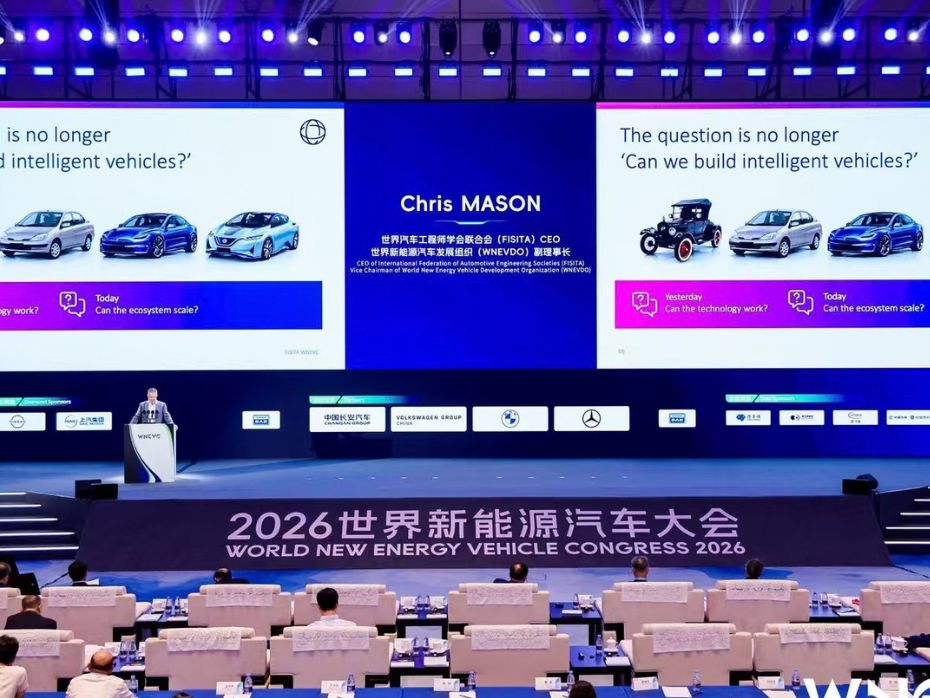
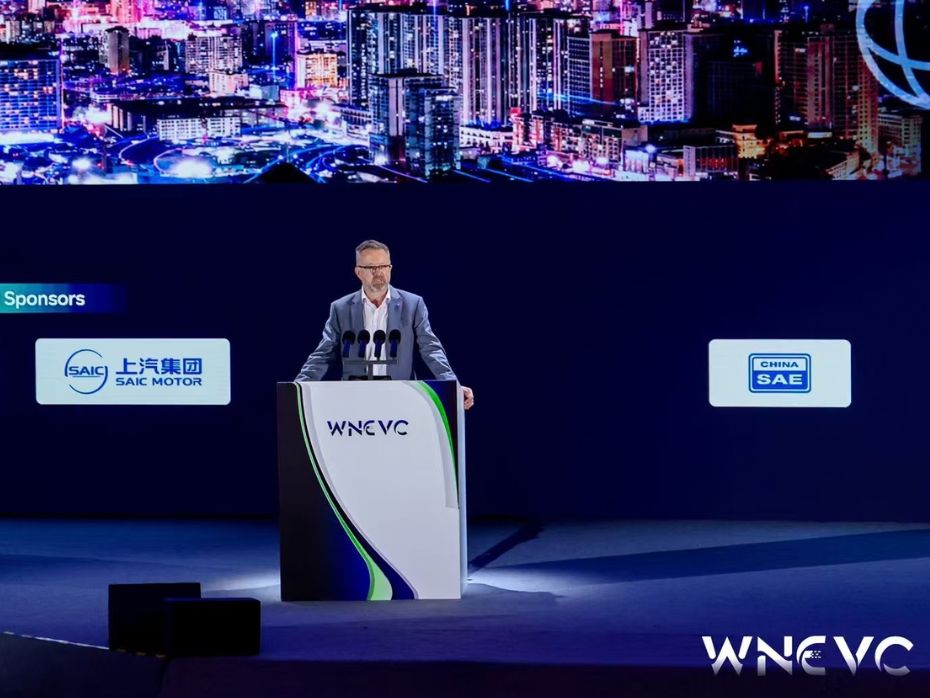
This article summarises the key messages from a keynote speech delivered by Chris Mason, CEO of FISITA, at the World New Energy Vehicle Congress (WNEVC) 2026. Reflecting on the unprecedented transformation taking place across the mobility sector, Chris highlighted why the future of intelligent and sustainable mobility will depend not only on technological innovation, but on the strength of the global ecosystem that supports it.
The mobility industry is undergoing the most significant transformation in its history. For more than a century, progress was driven largely by advances in mechanical engineering. Today, however, electrification, artificial intelligence, software-defined vehicles, connectivity and sustainability are converging simultaneously. This is not one transition but is several revolutions happening at the same time.
The question is no longer whether these technologies can work, we can already see the evidence on our roads around the world. The more important challenge is whether we can build the ecosystem that allows innovation to scale safely, sustainably and globally.
From vehicles to mobility systems
For decades, the automotive industry focused on improving vehicles, but today, we are increasingly shaping entire mobility systems.
Electrification is transforming propulsion while creating new energy and supply-chain ecosystems. Software-defined vehicles are changing how products are developed, maintained and experienced throughout their lifecycle. Artificial intelligence is accelerating everything from engineering and manufacturing to safety and automated driving technologies.
Together, these developments are creating a mobility ecosystem that is more connected, more intelligent and more interdependent than anything we have seen before. Success in this new era will depend not only on technological excellence, but on our ability to bring together expertise from multiple disciplines, industries and regions.
The new challenge: scaling innovation
A few years ago, many industry conversations centred on whether intelligent and connected vehicles could become a reality, today, the challenge is different. The questions are: How do we scale these technologies? How do we develop the skills, standards, regulations, infrastructure and public confidence required to support widespread adoption? These are ecosystem challenges.
No single company can solve them alone. Autonomous driving, battery sustainability, cybersecurity, charging interoperability and responsible AI require collaboration across manufacturers, suppliers, technology companies, universities, governments and regulators.
Innovation definitely happens within organisations, but transformation happens across ecosystems.
Trust will determine success
As the industry embraces greater intelligence and connectivity, trust becomes increasingly important and I strongly believe the technologies that succeed will not simply be the most advanced; they will be the most trusted.
That trust is built through safety, cybersecurity, responsible AI, transparency and robust governance. These are often seen as constraints on innovation, but in reality, they are enablers of adoption. Technology may advance rapidly, but societal acceptance develops through confidence and trust. In many ways, progress moves at the speed of trust.
Investing in the mobility engineer of the future
The future of mobility depends as much on people as it does on technology. Tomorrow’s mobility engineer will need a combination of traditional engineering knowledge and expertise in software, AI, data science, systems integration, cybersecurity and sustainability.
Developing this talent cannot be the responsibility of industry alone and it requires stronger collaboration between employers, universities, professional engineering organisations and policymakers.
This is why FISITA is launching its new Mobility Engineer 2050 initiative, bringing together global stakeholders to explore the skills and capabilities future mobility professionals will require in the decades ahead.
Global challenges require global cooperation
The biggest mobility challenges do not stop at national borders. Climate action, road safety, sustainable transportation and digital trust are global issues that require international cooperation. At a time when many industries are experiencing greater regionalisation and fragmentation, engineering remains a powerful force for connection.
Through its international network of industry members, engineering societies, universities and research organisations, FISITA provides a neutral platform for knowledge sharing and technical collaboration.
While markets may compete, the challenges facing mobility are shared, and our commitment to solving them must be shared too.
The opportunity ahead
The future of mobility will not be defined solely by the vehicles we build. It will be defined by the ecosystem we build around them. An ecosystem that develops talent, promotes responsible innovation, builds trust and connects the global engineering community.
No single company, country or technology will shape the future alone. The next era of intelligent and sustainable mobility will be determined by our collective ability to collaborate, share knowledge and learn from one another. That is not only the challenge before us, it is the opportunity.