
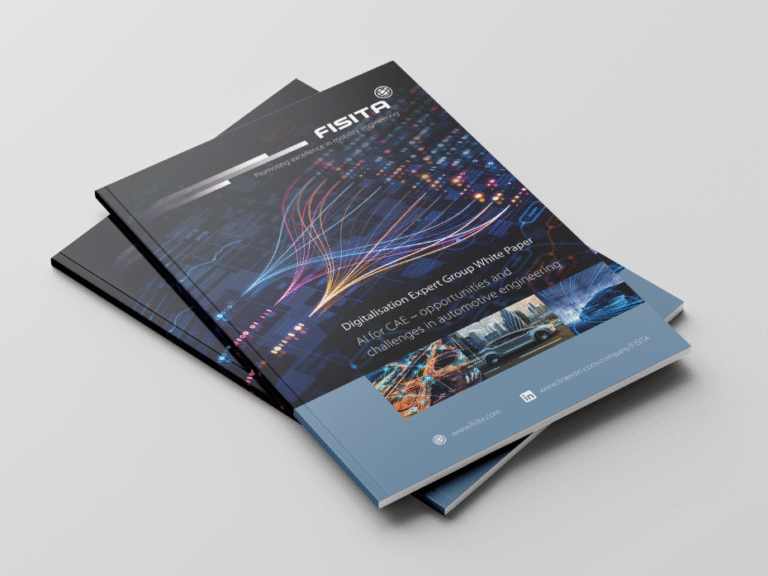
Digitalisation Expert Group white paper: AI for CAE – Opportunities and Challenges in Automotive Engineering
Artificial intelligence (AI)-driven simulation technologies are increasingly promoted as the ultimate goal for the automotive engineering community, promising accelerated vehicle development and breakthrough design capabilities.
Computer-Aided Engineering (CAE) has become a cornerstone technology in modern automotive development, revolutionising how vehicles are designed, tested, and optimised.
The broad acceptance of CAE in the automotive industry represents a fundamental shift in engineering methodology, from primarily empirical testing to a physics-based approach where physical testing serves mainly to validate digital predictions. This shift has become so complete that modern vehicle development would be practically impossible without CAE tools, particularly given today’s vehicle complexity with advanced propulsion systems, electronics, and safety features.
This white paper, produced by the FISITA Digitalisation Expert Group, aims to present the evolving landscape of the automotive engineering industry driven by the integration of AI and machine learning (ML). It is intended to serve as a guide for new users and to provide insights into future developments and trends in this rapidly advancing field.
Significantly, important questions remain:
- To what extent can machine learning solvers already deliver reliable, swift, and well-reasoned design decisions?
- What are the inherent drawbacks and risks of data-driven simulation methods?
- Which challenges must be addressed to enable large-scale implementation of machine learning solvers in safety-critical automotive engineering?
- How can geometry-aware machine learning methods transform design and simulation, and which obstacles still limit their practical adoption?
This white paper reviews the current state of the technology, assesses the feasibility of its rapid integration into vehicle development, and projects its potential for broader adoption across the automotive industry; this analysis is supported by case studies showcasing different applications of AI in simulation, including:
- Real-time prediction
- Predictive simulation
- Support for model generation
Contributors
This document was compiled by the FISITA Digitalisation Expert Group. Led by a sub-group of experts on AI and CAE, the report includes contributions from the following organisations:
- Applus+ IDIADA
- Forvia
- General Motors
- NIO
- OPmobility
- Renault
- Stellantis
Table of Contents
- Introduction – CAE in automotive
- Key applications of AI and ML in automotive CAE
- Benefits of AI and ML integration in automotive CAE
- Technical challenges and considerations
- Future trends and directions
- Conclusion
- Appendix: Industrial use-cases
- Prediction of joint stack failures
- GNN-based crash safety predictive modelling for VRU
- Optimal transport-based hybrid twin to enhance internal aerodynamics simulations
- LLMs to translate model formats
- Deep learning surrogate to iterate quickly on aerodynamics
- Machine learning for material card generation
- Reduced order model of advanced versatile seat
- Advancing industrial applications with 3D Gaussian Splatting
- Tailgate injection moulding surrogate model
- AI based model to improve slosh performance of fuel tanks
- e-Motor hybrid twin model
- Acknowledgements
Download the White Paper
Register to access the full white paper and gain a structured, expert-led perspective on the role of AI in automotive CAE – including practical use cases, current limitations, and future development pathways.