
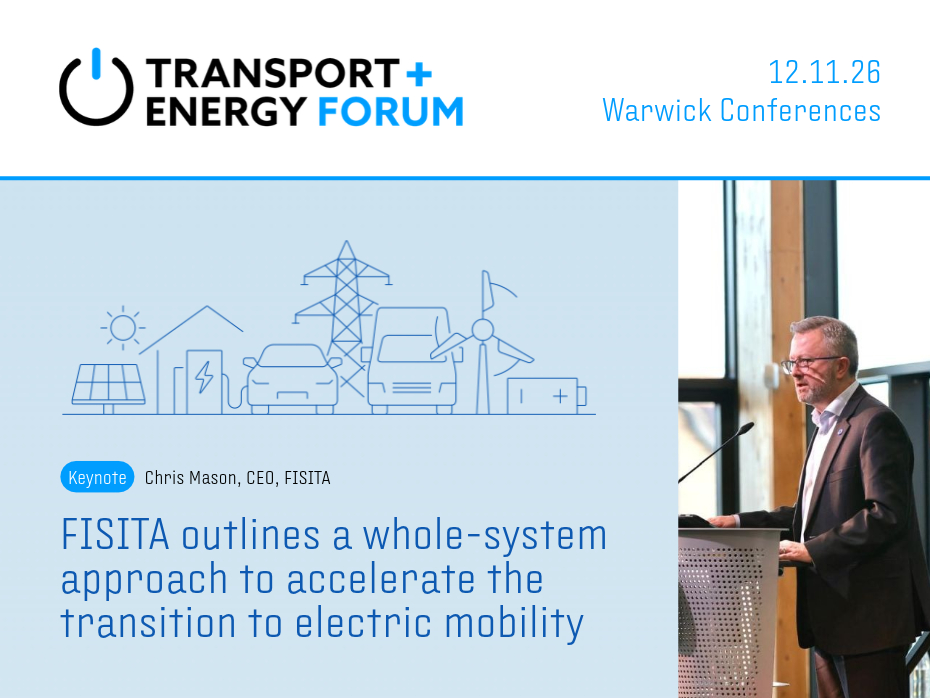
FISITA CEO Chris Mason highlights the need to connect transport, energy, infrastructure, skills and investment to turn electrification ambition into delivery
FISITA outlines a more integrated approach to the next phase of transport electrification, arguing that the challenge is no longer simply the development of electric vehicle technology, but the ability of the wider transport and energy ecosystem to deliver at scale.
Speaking at the Transport + Energy Forum 2026, FISITA CEO Chris Mason brought an international mobility perspective to the UK debate, looking at lessons emerging from markets around the world and the implications for future UK competitiveness.
His central message was clear: the EV transition will not be delivered by vehicles alone. It will be delivered by the system built around them, and by the ability to make transport and energy work as one.
Electric vehicle technology continues to advance rapidly, with increasingly capable, desirable and connected products entering the market. However, achieving adoption at scale depends on several interconnected conditions developing at a compatible pace:
affordable and attractive vehicles,
accessible and reliable charging,
sufficient electricity network capacity and flexibility,
long-term investment,
consistent policy and
skills required to deliver increasingly complex systems.
This reflects a fundamental change in the challenge facing the mobility community. The question is moving from whether electric vehicles can meet real-world requirements to whether the complete ecosystem around them can scale quickly and effectively enough.
Transport and energy are becoming one connected system
Electrification is changing much more than vehicle propulsion. As electric vehicles become increasingly integrated with homes, workplaces, charging infrastructure and electricity networks, the boundaries between transport and energy are becoming less distinct.
Smart charging, managed fleet charging and vehicle-to-grid technologies offer the potential for vehicles to become flexible energy assets rather than simply additional sources of electricity demand. At the same time, software, data and artificial intelligence can increasingly help forecast demand, optimise charging and make more effective use of existing network capacity.
Realising those opportunities, however, requires coordination between sectors that have historically planned and operated separately.
Automotive organisations need to understand energy and network requirements. Electricity networks require greater visibility of future transport demand. Chargepoint operators depend on timely connections. Local authorities need to coordinate infrastructure with communities, networks and operators. Digital platforms must be secure and interoperable.
For FISITA, that makes collaboration a fundamental part of the delivery model.
“There is still a vital role for competition. Companies should compete through their products, services, customer experience and execution,” said Chris Mason. “But there is also a substantial pre-competitive space where collaboration on areas such as skills, standards, safety, interoperability and technical frameworks can remove shared barriers and accelerate progress.
“Individual organisations can innovate brilliantly, but delivery at scale happens across organisational boundaries.”
Confidence is a system asset
The transition also depends on millions of individual investment and purchasing decisions.
Consumers need confidence that an electric vehicle is affordable, practical and supported by convenient charging. Fleets require confidence in capability, infrastructure and total cost of ownership. Infrastructure providers and electricity networks need sufficient confidence in future demand to invest, while businesses need a credible long-term direction against which to commit capital, technology and people.
Consistency across policy, standards and delivery therefore has a direct impact on investment and adoption.
Rather than treating confidence simply as a communications challenge, FISITA believes it should increasingly be recognised as an asset created by a system that works reliably and develops in a sufficiently consistent direction.
People will deliver the transition
Technology alone will not determine the speed of change. The transition requires automotive and battery engineers to work alongside power systems and grid engineers, charging specialists, software developers, data and cybersecurity professionals, infrastructure teams, planners, technicians and local authorities.
Increasingly, some of the most important capability sits between traditional disciplines, with people who understand enough of the wider system to identify trade-offs and make integrated decisions.
With 2030 approaching, FISITA believes recruitment, retraining and continuing professional development must therefore be treated as immediate priorities.
FISITA is also looking further ahead through its forthcoming Mobility Engineer 2050 initiative, which will consider how areas including artificial intelligence, software, advanced energy systems, automation and sustainability could transform the mobility engineering profession over the coming decades.
“The technology will enable the transition, but people with systems capability will deliver it,” said Mason.
A global race for capability and investment
The transition is taking place against an increasingly competitive international backdrop.
Countries and regions are competing to attract investment, technology, supply chains and skills. Infrastructure capability, access to talent, consistent policy and confidence in long-term demand are therefore becoming important elements of industrial competitiveness.
Rather than attempting to replicate another market wholesale, FISITA believes there is an opportunity for the UK to learn from different approaches internationally and become particularly effective at connecting its existing strengths in engineering, energy, digital technologies and financial services.
Through its international network, FISITA brings together mobility companies, engineering societies, universities, research institutions and technology leaders across major and emerging mobility markets. This provides a platform for pre-competitive technical dialogue and for sharing evidence and experience across national and organisational boundaries.
“No country has all the answers, and no market should have to learn every lesson alone,” Mason added. “Global insight can become a delivery advantage if it allows us to understand what is working elsewhere, adapt proven approaches more quickly and avoid unnecessary fragmentation.”
Three priorities for delivery
FISITA identified three priorities that can help move electrification from ambition towards coordinated delivery:
1
Plan transport and energy as one system
Align vehicles, charging, grid capacity, flexibility and local delivery from the outset.
2
Build confidence through consistency
Provide consumers, fleets, delivery partners, networks and investors with a sufficiently stable basis on which to make long-term decisions.
3
Develop the people and partnerships that make delivery possible
Invest in capability while strengthening collaboration between automotive, energy, infrastructure, technology, government, academia and the engineering community.
Together, these priorities can help turn technological capability into deployment, adoption and economic value.
“The EV transition will not be delivered by vehicles alone,” Mason concluded. “It will be delivered by the system we build around them, and by our ability to make transport and energy work as one.
“The opportunity is to connect our strengths and turn innovation into coordinated delivery, creating cleaner and more efficient transport, a more flexible and secure energy system, and an economy better equipped to compete in a rapidly changing world.”