
Automotive is entering an era where resource efficiency, regulatory pressure and supply‑chain resilience converge making circularity critical to every business
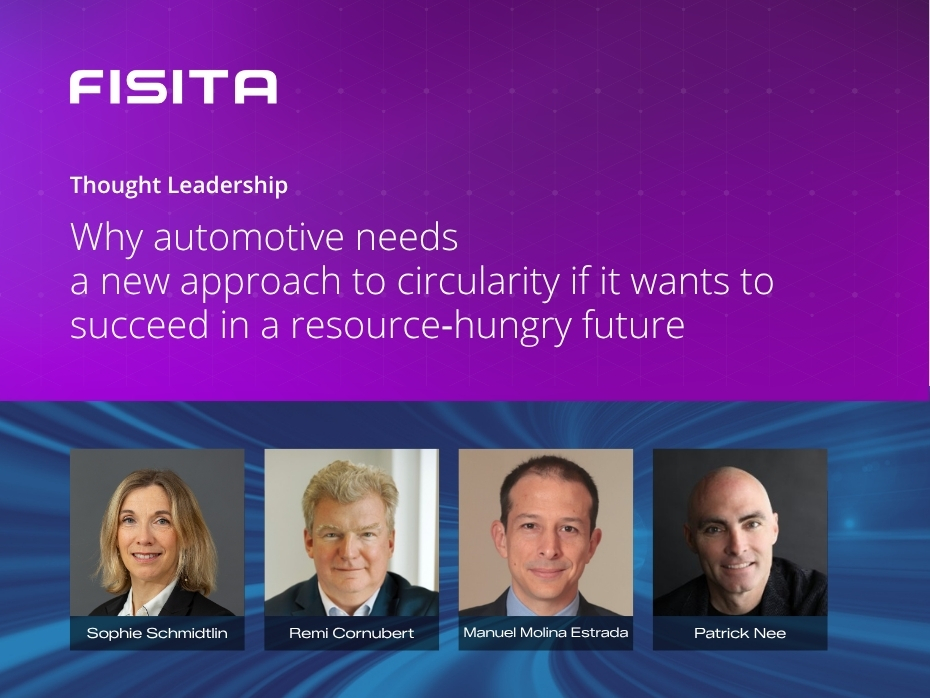
The circular economy is part of the mainstream as sustainability topic becomes a defining strategic pillar for the global automotive industry. As Sophie Schmidtlin from The Future Is Neutral, Manuel Molina Estrada from Toyota Motor Europe, Cyclic Materials’ Patrick Nee and Strat Anticipation’s Rémi Cornubert explored during FISITA Driving Circularity: A New Mindset to Achieve Sustainability webinar.
Schmidtlin opened with a stark reminder of the forces reshaping the industry. According to the International Energy Agency Global Critical Minerals outlook 2025, demand for transition‑critical materials is surging – lithium demand will grow by 470% by 2040 from 2024, rare earths 160% and copper 30%. At the same time, environmental impacts, geopolitics and ecosystem fragility are intensifying resource pressure. Circularity, she argued, is therefore not simply an environmental gesture but “a path to secure supply, improve environmental performance and enhance industrial sovereignty.”
But for all the pressures, the shift isn’t straightforward. The automotive circular ecosystem remains fragmented: thousands of collectors, dismantlers, and recyclers operating with limited traceability, inconsistent material flows and immature markets for reused and remanufactured parts. Economic hurdles – volatile virgin material prices, high upfront investment, and slow adoption of usage‑based business models – remain barriers to scaling approaches to increase circularity’s impact.
Regulation as a catalyst
Across regions, regulatory frameworks are accelerating. Europe leads with binding lifecycle requirements on design, recycled content, traceability and producer responsibility. China is scaling rapidly through mandatory recycling rates and industrialised battery recycling. Japan and India are building long‑term frameworks, while the US remains innovation‑driven but fragmented.
For OEMs, this shift is already reshaping R&D. Molina outlined Toyota’s response: embedding circularity into the earliest design stages through design for circularity and recycled‑content integration. Toyota has set a global voluntary target of 30% recycled content in new vehicles introduced after 2030, and is preparing for Europe’s upcoming ELV regulation, which will require declarations of recycled steel, aluminium, plastics, magnesium and rare earths from 2029 onwards.
Meeting these targets requires new traceability systems, supplier collaboration, and, critically, access to high‑quality recycled feedstock. Toyota’s emerging “Circular Factories” in the UK and Poland aim to secure precisely that.
If circularity is essential for mainstream materials, as the industry shifts to an electrified future, rare earths become a critical component of any circular future. As Nee explained, demand for magnet‑grade rare earth elements is rising sharply, yet recycling rates remain around 1%. Among the issues; magnets stick to steel and are lost to slag in steel refineries.
Cyclic Materials is tackling this through a long‑loop recycling process that chemically recovers rare earth oxides identical to virgin material. Its automated technology recovers magnets from end‑of‑life motors in everything from EV drive units to power steering pumps and speakers, alongside copper, aluminium and steel. The result is a secure, traceable, low‑carbon supply of critical materials that can be fed back into new motors at scale.
Shifting engineering mindsets
Cornubert reminded everyone that circularity is not only a technical challenge, but a strategic one. Recycled materials reduce environmental impact, mitigate supply shocks and, in many cases, lower cost. But unlocking these benefits requires engineers to become “architects of circular systems,” integrating eco‑design, modularity, repairability and recyclability from the outset.
It also requires new business models that account for the full lifecycle cost of a vehicle – from production to maintenance to end‑of‑life recovery. Digital product passports, transparent material databases and auditable lifecycle assessments will underpin this shift.
Circularity will only scale if it is competitive, profitable and collaborative. The message from all four speakers was consistent: no single company can build a circular ecosystem alone. OEMs, recyclers, dismantlers, material producers, insurers and policymakers must align around shared standards, shared data and shared incentives.
Automotive is entering a new era, where value is measured not only in performance and cost, but in longevity, recoverability and resource stewardship. It’s a direction that puts circularity at the forefront of the industry’s success.
About the speakers
Sophie Schmidtlin is Chief Technology Officer at The Future is Neutral, Manuel Molina Estrada is Senior Manager in R&D Technology Strategy Planning at Toyota Motor Europe, Remi Cornubert is Founder and President of Strat Anticipation, and Patrick Nee is Co-founder of Cyclic Materials.
Watch the FISITA Driving Circularity: A New Mindset to Achieve Sustainability webinar.
Find out more about the Circular Economy Expert Group, become a member, and help contribute to the advancement of the mobility and automotive sectors.