
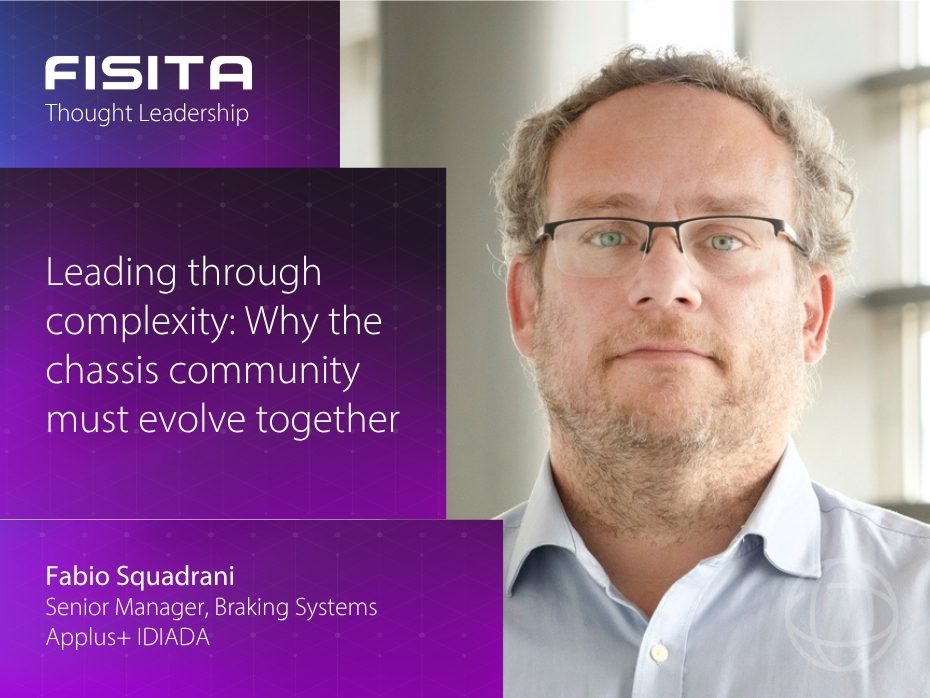
Navigating complexity will lead to opportunities but the global community needs to come together to navigate the challenges with clarity, ambition and collaboration writes Fabio Squadrani.
When we created the FISITA Advanced Chassis Technology Expert Group, it came from a simple but powerful realisation: everything we care about in mobility ultimately comes down to the interface where the vehicle meets the road. It sounds basic, yet this interface is now under more pressure than at any point in the history of vehicle development. That pressure is exactly why this group exists; helping us to understand, shape and lead the holistic transformation unfolding across our industry.
The group’s diverse community with experts from OEMs, Tier Ones, service and testing companies, and a strong presence from academia gives us credibility and, more importantly, a collaborative spirit that allows us to tackle challenges.
Megatrends reshaping our world
Early in our work, we defined the driving changes in the chassis domain. Electrification was the first. It has created what I often call the mass-performance paradox: vehicles with extreme mass distribution and commercial platforms capable of Formula 3‑level acceleration, transforming braking.
Regulation is another major force. Euro 7 has dominated discussions, but tyres are emerging as the next frontier. Dust emissions and microplastic generation are now recognised as contributors to environmental and health issues, with studies linking particulate matter to respiratory and cardiovascular disease.
At the same time, the rise of the software‑defined vehicle is reshaping our work. Chassis behaviour is increasingly determined by software, not hardware. Over‑the‑air updates mean the vehicle is no longer a fixed product but a constantly evolving platform. In this context, hardware becomes “nothing more than a platform,” and differentiation moves into algorithms.
Even the corner module – once a purely mechanical assembly – has changed. Today the corner is an intelligent node able to receive information, process information, and generate data.
And then there is artificial intelligence. Within our group, we see AI operating at three levels: real‑time vehicle control, accelerated development processes, and predictive intelligence for connected vehicles. From adaptive suspension control to generative design and predictive maintenance, AI isn’t only a tool but a driving force.
Each of these trends would be transformative on its own, but together, they demand new solutions and, more importantly, new ways of thinking.
The value of collaboration
Within the Expert Group, we have focused not only on solutions but on asking the right questions. Members have contributed presentations on brake emissions, integrated chassis concepts, development acceleration and AI‑enabled methodologies.
Our aim is not to produce a theoretical exercise, but to set a level of understanding that the global technical community can use to discuss challenges, techniques and long‑term vision.
Looking ahead, we see two major tasks. The first is harmonising global standards. Diverging regulations risk slowing innovation, and we believe global chassis organisations can accelerate progress rather than constrain it. The second is helping shape academic curricula. Future chassis engineers will need multidisciplinary skills – strong technical foundations, but also data analytics, cybersecurity, AI literacy and transversal knowledge.
I often say this is possibly the most challenging time to be a chassis engineer. The fundamentals remain – vehicle dynamics, materials, longitudinal behaviour – but the possibilities are expanding rapidly. Right now complexity is real, but so too is the opportunity.
That is why this Expert Group matters. Together, we can make sense of this transformation and help the global community navigate it with clarity, ambition and collaboration.
About the author
Fabio Squadrani is Senior Manager for Braking Systems at IDIADA
Find out more about the Advanced Chassis Technology Expert Group, become a member, and help contribute to the advancement of the mobility and automotive sectors.